
Moving Truck Gas Mileage: U-Haul, Penske & Budget MPG by Truck Size
Fuel is the moving-day cost most people guess at. The rental quote covers the truck and the miles, but you buy every gallon yourself, and a loaded box truck burns two to three times as much fuel per mile as the car you drive every day. On a long move the fuel bill can rival the rental itself.
This guide collects the gas mileage, fuel type and tank size that U-Haul, Penske and Budget publish for each truck, shows how to turn those numbers into a fuel budget, and explains why your truck will probably do a little worse than the brochure. All prices are the AAA national averages for October 7, 2026: $4.37 for regular and $6.30 for diesel.
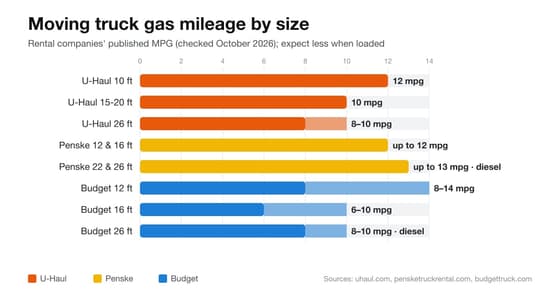
Moving Truck MPG by Company and Size
Each company publishes an MPG figure and tank size on its truck pages. U-Haul lists a single number (a range for its 26-foot truck), Penske lists a maximum (“up to”), and Budget lists a range. All three say the figures are estimates that vary with load, terrain, weather and speed.
| Truck | Fuel | Published MPG | Tank | Miles per tank |
|---|---|---|---|---|
| U-Haul 10 ft | Regular unleaded | 12 | 31 gal | up to 372 |
| U-Haul 15 ft | Regular unleaded | 10 | 40 gal | up to 400 |
| U-Haul 17 ft | Regular unleaded | 10 | 40 gal | up to 400* |
| U-Haul 20 ft | Regular unleaded | 10 | 40 gal | up to 400 |
| U-Haul 26 ft and 29 ft | Regular unleaded | 8–10 | 60 gal | up to 600 |
| Penske 12 ft and 16 ft | Gasoline (regular) | up to 12 | up to 33 gal | up to 396* |
| Penske 22 ft and 26 ft | Diesel | up to 13 | up to 70 gal | up to 910* |
| Budget 12 ft | Gasoline | 8–14 | 35 gal | 280–490* |
| Budget 16 ft | Gasoline | 6–10 | 33 gal | 198–330* |
| Budget 26 ft | Diesel | 8–10 | 50 gal | 400–500* |
Figures from each company’s truck pages, checked October 7, 2026. *Miles per tank is the tank size times the published MPG, worked out by us; U-Haul publishes its own “up to” ranges for the trucks without an asterisk. Penske notes that diesel applies to “some models” of its 26-foot truck.
If your load fits in a van, the numbers are far better: U-Haul rates its cargo van at 18 MPG and its pickup at 19 MPG, while Penske lists up to 12 MPG for its cargo van and Budget 8–14 MPG for its own.
How to Estimate the Fuel Cost of Your Move
Moving fuel works exactly like any road-trip fuel estimate: work out the gallons, then multiply by the price.
Example 1: Across town in a 10-foot truck
A local move with a couple of loading runs adds up to about 60 miles. At U-Haul’s 12 MPG: 60 ÷ 12 = 5 gallons × $4.37 = about $22.
Example 2: A 500-mile move in a 15-foot truck
At the published 10 MPG: 500 ÷ 10 = 50 gallons × $4.37 = about $219. A full load, hills or highway speeds can pull a truck down to around 8 MPG, which makes it 62.5 gallons, or about $273. Budget toward the higher figure. With a 40-gallon tank you will also need at least one fuel stop on the way.
Example 3: A 1,500-mile move in a 26-foot truck
The biggest trucks show how much the truck you pick changes the bill:
- U-Haul 26 ft (gasoline, 8–10 MPG): 150 to 187.5 gallons × $4.37 = $656 to $819.
- Budget 26 ft (diesel, 8–10 MPG): 150 to 187.5 gallons × $6.30 = $945 to $1,181.
- Penske 26 ft (diesel, up to 13 MPG): at its best-case 13 MPG, about 115 gallons × $6.30 = about $727. Penske’s own fuel estimator assumes 8 MPG for these trucks, which would match Budget’s upper figure.
Prefer not to do the math? Enter the distance, the truck’s MPG and local gas prices in our trip gas cost calculator, and use the fuel tank range calculator to see how far you can go between stops. As a per-mile figure, a 10-MPG truck at $4.37 costs about 44 cents a mile in fuel (cost per mile calculator).
Why Real-World MPG Is Usually Lower
The published figures are best cases. U-Haul calls its numbers “estimations for ideal driving circumstances,” and lists driving with a load, road grades, weather and speed among the things that lower them. Several facts point the same way:
- These trucks are not EPA tested. Vehicles over 8,500 pounds gross vehicle weight are heavy-duty, and fuel economy regulations do not apply to them, so they are not tested. Rental box trucks are rated from 8,600 pounds (U-Haul’s 10-foot) to about 26,000 pounds (the 26-footers), so every MPG figure above is the rental company’s own estimate, not a lab result.
- Weight matters. FuelEconomy.gov notes that extra weight cuts fuel economy in proportion to how heavy the load is relative to the vehicle. A moving truck packed with furniture is carrying thousands of pounds it does not carry on a test drive.
- Speed costs more in a box. A tall, flat-fronted truck pushes a lot of air, and gas mileage usually decreases rapidly at speeds above 50 mph. Our guide to speed and fuel economy shows how quickly that adds up.
- The fleet average is low. Across the U.S., single-unit trucks (the class that includes box trucks) averaged 8.1 MPG in 2024, according to the Federal Highway Administration.
Penske’s own fuel estimator reflects this: it uses an average of 8 MPG for its diesel 22- and 26-foot trucks and 6 MPG for gasoline ones, well below the “up to 13 MPG” on the truck pages. For budgeting, take the low end of the published range, or about 8 MPG for a mid-size or large truck.
Gas or Diesel: Which Truck Costs Less to Fuel?
Every U-Haul truck runs on regular unleaded. Penske’s 12- and 16-foot trucks and Budget’s cargo van, 12- and 16-foot trucks use gasoline too, while Penske’s 22- and 26-foot trucks and Budget’s 26-footer are diesel. Diesel engines go farther on a gallon, but in October 2026 a gallon of diesel costs about $1.93 more than regular ($6.30 against $4.37).
Using Penske’s own averages of 8 MPG for diesel and 6 MPG for gasoline, 1,000 miles costs about $788 in diesel and $728 in gasoline at today’s prices, so the gas truck is cheaper. A year earlier, with diesel at $3.68 and regular at $3.12 (AAA), the same 1,000 miles cost about $460 in diesel against $520 in gas. Which fuel is cheaper depends on the price gap that week, so run both numbers before you book.
Towing a Car Behind the Truck
Towing your car on a dolly or a car trailer adds the trailer’s weight (740 pounds for U-Haul’s tow dolly, 2,210 pounds for its auto transport, both empty) plus the car itself, and it adds drag. U-Haul says plainly that towing does reduce a moving truck’s MPG, and it caps the recommended speed for both towing options at 55 mph.
No company publishes a towing MPG, so plan for the bottom of your truck’s range or a little below it, and check your real mileage at the first fill-up. Our guide to towing gas mileage shows how much MPG a trailer typically costs and how to budget for it. If the truck has a Tow/Haul mode, U-Haul suggests switching it off when you are not towing.
Refueling Rules Before You Return the Truck
None of the three companies includes fuel in the rental. Each has its own return rule, and topping up yourself is almost always cheaper than letting them do it:
- U-Haul: return the truck with the same amount of fuel it had at pickup; the level is marked on your contract. Trucks returned with less than a quarter tank are subject to an extra $30 service fee. Its EZ-Fuel option refuels for you at a per-gallon price shown on your contract.
- Penske: trucks leave with a full tank. Penske says there are no fuel charges if you return the truck with the same fuel level, and its return checklist asks for a full tank.
- Budget: trucks normally leave full and must come back full. Otherwise Budget adds a refueling service charge plus fuel billed in eighths of a tank at a per-gallon rate that may be higher than retail, and it does not reimburse extra fuel you leave in the tank.
Fill up at a station a few miles from the return location so the gauge still reads full when you drop the truck off, and keep the receipt.
How to Spend Less on Fuel During a Move
- Keep it at 55–60 mph. A U-Haul towing expert put it bluntly: “The difference between 55 MPH and 65 MPH is huge.”
- Use regular gas in gasoline trucks. U-Haul says its trucks are designed for regular unleaded and premium is not necessary. See whether premium gas is worth it in general.
- Pick the smallest truck that fits in one trip. A 10-foot truck at 12 MPG uses about 17% less fuel per mile than a 15-footer at 10 MPG, but a second round trip wipes that out quickly.
- Plan stops around a quarter tank. A 40-gallon tank that is refilled at a quarter full gives about 300 miles between stops at 10 MPG, or 240 at 8 MPG. Our guide to planning fuel stops walks through it.
- Don’t idle while loading. A parked engine burns fuel for zero miles; see how much fuel idling uses.
- Compare diesel and gas trucks with that week’s prices. When diesel costs far more than regular, a gas truck can be the cheaper rental to fuel.
Estimate the Fuel Cost of Your Move
Enter the distance, your truck’s MPG and the gas price along your route.
Open the Trip Gas Cost CalculatorFrequently Asked Questions
How many miles per gallon does a 26-foot U-Haul get?
U-Haul lists its 26-foot truck at 8 to 10 MPG on regular unleaded, with a 60-gallon tank that it says is good for up to 600 miles. Budget’s diesel 26-footer is also listed at 8 to 10 MPG, and Penske’s diesel 26-foot truck at up to 13 MPG. Loaded trucks usually land near the low end.
Do U-Haul trucks take regular gas or diesel?
All U-Haul trucks, including the 26-foot truck, run on unleaded gasoline, and U-Haul says regular is fine—premium is not necessary. Penske’s 22- and 26-foot trucks and Budget’s 26-foot truck are the ones that use diesel.
How much gas does a 15-foot U-Haul hold?
A 15-foot U-Haul has a 40-gallon tank. At its rated 10 MPG that is up to 400 miles on a full tank, and filling it from empty costs about $175 at $4.37 a gallon. The 17- and 20-foot trucks also have 40-gallon tanks; the 10-foot has 31 gallons and the 26-foot 60.
How much does gas cost for a 500-mile move?
In a 15- or 20-foot truck rated at 10 MPG, a 500-mile move takes about 50 gallons, roughly $219 at the October 2026 national average of $4.37 for regular. If the loaded truck averages 8 MPG, it is about 62.5 gallons, or $273. Add the miles for pickup, loading runs and the return.
Do I have to fill up a rental truck before returning it?
U-Haul asks for the same fuel level you received and adds a $30 fee if the truck comes back under a quarter tank. Penske and Budget hand trucks over full and expect them back with the same level, usually full. Budget charges a refueling service fee plus a per-gallon rate that may be above retail if you don’t refill.
Does towing a car lower a moving truck’s gas mileage?
Yes. U-Haul says towing reduces a moving truck’s MPG because of the extra weight and drag, and it recommends no more than 55 mph with its tow dolly or auto transport. No rental company publishes a towing MPG, so plan for the bottom of the truck’s range.
Sources & References
- U-Haul — Truck Rentals (MPG and miles per tank by truck)
- U-Haul — 15′ Moving Truck specifications
- U-Haul — 26′ Moving Truck specifications
- U-Haul — How to Save Gas While Driving a Moving Truck
- U-Haul — How Much Fuel to Add Before Returning a Moving Truck
- U-Haul — Truck Rental FAQ
- U-Haul — Tow Dolly and Auto Transport specifications
- U-Haul — Towing Tips From an Expert
- Penske Truck Rental — Trucks and Vans
- Penske Truck Rental — Fuel Savings Estimator
- Penske Truck Rental — Important Rental Information
- Budget Truck Rental — 16′ Truck and 26′ Truck details
- Budget Truck Rental — Which Fuel Does My Truck Use?
- Budget Truck Rental — Rental Terms and Conditions
- AAA — Gas Prices (national averages, October 7, 2026)
- U.S. Energy Information Administration — Gasoline and Diesel Fuel Update
- FuelEconomy.gov — Driving More Efficiently
- FuelEconomy.gov — Which Vehicles Are Tested
- Federal Highway Administration — Highway Statistics 2024, Table VM-1