
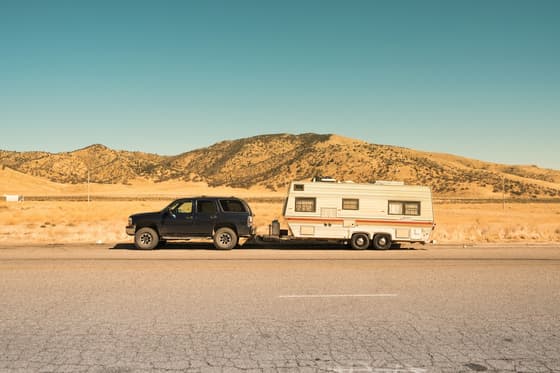
Towing Gas Mileage: How Much MPG You Lose and What It Costs
Hitch up a camper, a boat or a loaded utility trailer and your truck’s fuel gauge starts moving in a way it never does on the daily commute. That is not your imagination, and it is not a sign something is wrong. Towing gas mileage is simply much lower than the number on your window sticker, because that number was measured without a trailer.
This guide explains how much MPG you can expect to lose when towing, where the best data comes from, how to turn it into a fuel budget for a camping trip or a season at the lake, and what actually helps. Prices are the AAA national averages for November 2, 2026: $4.17 for regular and $6.29 for diesel.
How Much Does Towing Reduce Gas Mileage?
The most useful public measurement comes from Oak Ridge National Laboratory, which tests fuel economy for the Department of Energy and FuelEconomy.gov. In a 2014 study, ORNL researchers put a 2009 Ford Explorer (4.0-liter V6) on a dynamometer and ran it with and without a 3,500-pound enclosed cargo trailer. They called the results “rather dramatic”:
- About 30% lower fuel economy on the city test cycle.
- About 50% lower fuel economy at 80 mph, where the engine was working so hard it began running rich to protect itself, sending carbon monoxide emissions up sharply.
That 30% to 50% band is a sound planning range for most mid-size trailers: campers, enclosed cargo trailers and boats in the 3,000- to 7,000-pound class. Where your own rig lands inside it depends mostly on three things: how tall and blunt the trailer is, how heavy it is relative to the tow vehicle, and how fast you drive.
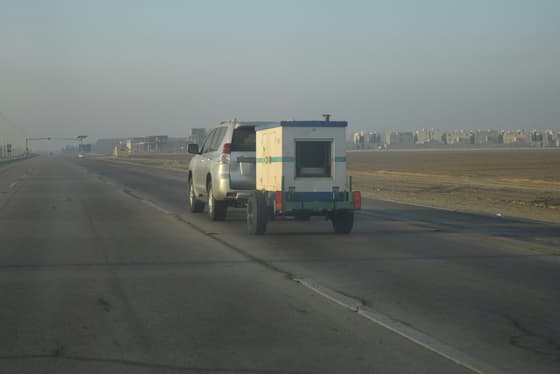
An SUV with an enclosed cargo trailer, close to ORNL’s test setup. Photo: Jay Openiano / Unsplash
Why your window sticker doesn’t cover towing
The EPA ratings on the label are measured under conditions that never include a trailer. FuelEconomy.gov notes that vehicles are assumed to carry only 300 pounds of passengers and cargo during testing, that the test assumes flat ground, and that “towing a trailer or carrying excessive weight decreases fuel economy.” No towing MPG is published for any vehicle, so the number you plan with has to come from a percentage reduction like the one above—or, better, from your own fill-ups. (For how the sticker figures are built, see our guide to the EPA fuel economy label.)
Small and low trailers lose less
A light, low utility trailer that sits in the tow vehicle’s wake adds little air resistance. FuelEconomy.gov’s cargo figures show how much shape matters: a rear-mounted cargo box or tray costs only 1% to 5% on the highway, while a blunt roof-top box costs 6% to 17%, and 10% to 25% at 65 to 75 mph. Something that sticks up into the airstream hurts far more than something that hides behind the vehicle. That is why a tall travel trailer that stands above the truck’s roof sits at the top of the towing range, while a small open trailer may cost you closer to 10% to 20%: by FuelEconomy.gov’s weight rule of thumb (below), a 1,000-pound trailer and load works out to about 10%, plus a little for drag. Our posts on roof racks and drag and roof boxes versus rear carriers cover the same effect for cargo.
Towing MPG and Fuel Cost by Vehicle
Start from the MPG your tow vehicle actually gets without a trailer (your own fill-up average, or the EPA combined figure), then apply a 30%, 40% or 50% reduction. The table shows the result and the fuel cost per 100 miles at $4.17 a gallon.
| MPG without trailer | Fuel per 100 mi, solo | 30% loss | 40% loss | 50% loss |
|---|---|---|---|---|
| 15 MPG | $27.80 | 10.5 MPG · $39.71 | 9.0 MPG · $46.33 | 7.5 MPG · $55.60 |
| 18 MPG | $23.17 | 12.6 MPG · $33.10 | 10.8 MPG · $38.61 | 9.0 MPG · $46.33 |
| 20 MPG | $20.85 | 14.0 MPG · $29.79 | 12.0 MPG · $34.75 | 10.0 MPG · $41.70 |
| 22 MPG | $18.95 | 15.4 MPG · $27.08 | 13.2 MPG · $31.59 | 11.0 MPG · $37.91 |
| 25 MPG | $16.68 | 17.5 MPG · $23.83 | 15.0 MPG · $27.80 | 12.5 MPG · $33.36 |
Towing MPG = solo MPG × (1 − loss). Cost per 100 miles = 100 ÷ MPG × $4.17 (AAA national average for regular, November 2, 2026). Use 30% for city driving or a modest trailer, 50% for a tall camper at 70+ mph.
Two things stand out. First, towing roughly doubles the fuel cost per mile at the heavy end. Second, the gap between 40% and 50% loss—often just the difference between 60 and 75 mph—is worth $5 to $10 per 100 miles in a typical truck.
Why Towing Burns So Much More Fuel
- Air resistance. A travel trailer or enclosed trailer is often taller and wider than the vehicle pulling it, so it pushes its own wall of air. Drag climbs quickly with speed, which is why FuelEconomy.gov warns that gas mileage usually decreases rapidly above 50 mph, and why ORNL’s trailer penalty grew from 30% to 50% as speed rose. More in our guide to speed and fuel economy.
- Weight. Every pound has to be accelerated from each stop and lifted up every hill, and the trailer’s tires add rolling resistance. This is the part that shows up most in town, where ORNL measured the 30% penalty.
- Hills. FuelEconomy.gov notes that hilly or mountainous terrain reduces fuel economy, and the EPA test assumes flat ground. With a trailer, a long grade can push the engine to full load for miles.
- The engine runs rich under heavy load. At high load, engines add extra fuel to keep temperatures in check. ORNL saw this at 80 mph with the trailer, and it is pure waste from a fuel-economy point of view.
How to Calculate the Fuel Cost of Towing
Towing fuel cost uses the same math as any road-trip fuel estimate. The only extra step is adjusting your MPG first.
Example 1: A weekend camping trip with a travel trailer
A pickup that averages 20 MPG solo tows a mid-size travel trailer 150 miles each way, 300 miles total. Planning for a 40% to 50% loss gives 10 to 12 MPG:
- At 12 MPG: 300 ÷ 12 = 25 gallons × $4.17 = about $104.
- At 10 MPG: 300 ÷ 10 = 30 gallons × $4.17 = about $125.
- Without the trailer: 15 gallons, or about $63. The camper adds $42 to $63 to the weekend.
Example 2: A season of trips to the lake with a boat
An SUV that gets 22 MPG solo pulls a small boat 60 miles each way to the lake. A low boat on a trailer sits toward the light end, so plan on a 30% loss: 22 × 0.7 = 15.4 MPG.
- Per trip: 120 ÷ 15.4 = 7.8 gallons × $4.17 = about $32.49, against $22.75 without the boat.
- That is about $9.75 extra per trip, or roughly $117 over a 12-trip season.
Example 3: A 2,000-mile road trip pulling a camper
A truck that averages 18 MPG solo pulls a tall travel trailer cross-country. At 70 to 75 mph, plan for the full 50% loss, or 9 MPG. Slowing to around 60 mph can keep the loss nearer 40% (10.8 MPG):
- At 9 MPG: 2,000 ÷ 9 = 222 gallons × $4.17 = about $927.
- At 10.8 MPG: 2,000 ÷ 10.8 = 185 gallons × $4.17 = about $772.
- Driving slower saves about $154 on the trip. The same truck without the trailer would spend about $463.
To run your own numbers, enter the distance, your towing MPG and the local gas price in our trip gas cost calculator. Our cost per mile calculator turns the same inputs into a per-mile figure: 12 MPG at $4.17 is about 35 cents a mile, against 21 cents solo at 20 MPG.
Range and Fuel Stops With a Trailer
Lower towing gas mileage shrinks your range by exactly the same percentage, and running low with a trailer is more stressful than in a car: not every station has room to pull a 30-foot rig through.
Take a truck with a 26-gallon tank. Solo at 20 MPG it can go about 520 miles on a full tank. Towing at 11 MPG, the same tank is good for about 286 miles, and if you refill at a quarter tank, you are stopping roughly every 215 miles instead of every 390.
Plug your tank size and towing MPG into the fuel tank range calculator, then use our method for planning fuel stops on a road trip to pick stations before you leave. Truck stops and stations with pull-through lanes are the easiest with a trailer.
How to Measure Your Own Towing MPG
Because every trailer has a different shape and weight, your own measurement beats any published range. Use the fill-to-fill method:
- Fill the tank completely before you hitch up, and reset a trip odometer.
- Tow as normal. At the next fill-up, fill completely again and note the gallons from the pump.
- Divide the miles on the trip odometer by those gallons. That is your towing MPG.
Our gas mileage calculator does the division for you, and the step-by-step guide on how to calculate miles per gallon explains why the pump figure is more reliable than a dashboard readout. Note the trailer, the cruising speed, the terrain and any headwind with each result. After two or three tanks you will know your rig’s real towing MPG and how much speed costs you.
Gas or Diesel for Towing?
Diesel engines are popular for towing because they deliver more torque and usually more miles per gallon under load. In an instrumented test by The Fast Lane Truck, a 2020 Chevrolet Silverado 1500 with the 3.0-liter Duramax diesel returned 12 MPG while towing 7,000 pounds on the outlet’s 66-mile loop, against 34 MPG empty.
Better mileage only saves money if it beats the price gap. On November 2, 2026, diesel averaged $6.29 against $4.17 for regular, so diesel cost about 51% more per gallon.
At today’s prices, a diesel tow vehicle needs about 51% better towing MPG just to break even on fuel. A year ago the gap was much smaller ($3.68 against $3.04, per AAA), so it pays to run this check with current prices before buying a truck for its fuel savings. Our fuel savings calculator compares two vehicles over a full year of driving.
How to Improve Towing Gas Mileage
- Slow down. Speed is the biggest lever you control. ORNL’s penalty grew from 30% to 50% as speed climbed, and FuelEconomy.gov estimates that each 5 mph over 50 is like paying about $0.30 more per gallon even without a trailer. Some states also set lower limits for towing: in California, the maximum is 55 mph for vehicles towing trailers.
- Pack light and travel with empty tanks where it is safe. Water weighs about 8.3 pounds per gallon, so a full 40-gallon fresh-water tank adds about 330 pounds. Fill up at the campground if you can.
- Check tire pressure on the vehicle and the trailer. ORNL found that low tire pressure cost up to 10% in fuel economy on its own. Inflate to the vehicle placard and the trailer tire’s recommended pressure. See tire pressure and fuel economy.
- Choose and load the trailer for low drag. A lower, narrower trailer that stays within the tow vehicle’s profile costs less fuel. Lower boat canopies and fold-down tops, and don’t leave cargo strapped on top.
- Use 2WD when 4WD isn’t needed. FuelEconomy.gov notes that using four-wheel drive reduces fuel economy.
- Follow your owner’s manual on Tow/Haul mode and fuel grade. Tow/Haul mode changes shift points to manage heat and braking. Use it as the manufacturer recommends. Premium fuel helps only where the manual recommends it for towing; see whether premium gas is worth it.
- Plan the route and don’t idle. Steady roads beat stop-and-go, and an idling engine burns fuel for zero miles. See how much fuel idling uses.
Estimate Your Towing Fuel Cost
Enter your trip distance, your towing MPG and the gas price on your route.
Open the Trip Gas Cost CalculatorFrequently Asked Questions
How much does towing reduce gas mileage?
Usually 30% to 50%. In an Oak Ridge National Laboratory test for the Department of Energy, an SUV towing a 3,500-pound enclosed trailer lost about 30% of its fuel economy in city driving and about 50% at 80 mph. Small, low trailers lose less; tall campers at highway speed sit at the top of the range.
What MPG should I use to estimate towing fuel cost?
Multiply your normal MPG by 0.5 to 0.7. A truck that averages 20 MPG solo will typically get 10 to 14 MPG towing. Use the lower figure for a tall travel trailer at 65 mph or more, and replace the estimate with your own fill-to-fill measurement after your first tank.
Does a small utility trailer affect gas mileage?
Yes, but much less than a camper. A light, low trailer adds weight and rolling resistance but little air drag because it rides in the vehicle’s wake. By FuelEconomy.gov’s rule of about 1% per 100 pounds, a 1,000-pound trailer and load works out to roughly 10%, so plan on 10% to 20% depending on speed, and measure it on your next fill-up.
How far can I drive on a tank when towing?
Multiply your tank size by your towing MPG. A 26-gallon tank at 11 MPG gives about 286 miles, compared with about 520 miles at 20 MPG without the trailer. Refilling at a quarter tank means stopping about every 215 miles.
Does driving slower really save fuel when towing?
Yes. Air drag rises quickly with speed, and a trailer adds a lot of it. ORNL’s towing penalty grew from about 30% in city driving to 50% at 80 mph. On a 2,000-mile trip in an 18-MPG truck, keeping the loss to 40% instead of 50% saves about $154 at $4.17 a gallon.
Is a diesel truck cheaper to tow with?
Only if its MPG advantage beats the price gap. With diesel at $6.29 and regular at $4.17 (AAA, November 2, 2026), a diesel needs about 51% better towing MPG to match a gas truck’s fuel cost. For example, 15.1 MPG on diesel costs the same per mile as 10 MPG on gas.
Sources & References
- Oak Ridge National Laboratory — ORNL Study Pegs Fuel Economy Costs of Common Practices (April 9, 2014)
- Thomas, Huff & West — Fuel Economy and Emissions Effects of Low Tire Pressure, Open Windows, Roof Top and Hitch-Mounted Cargo, and Trailer (SAE 2014-01-1614)
- FuelEconomy.gov — Many Factors Affect MPG
- FuelEconomy.gov — Driving More Efficiently
- AAA — Gas Prices (national averages, November 2, 2026)
- The Fast Lane Truck — Chevy vs Ram 1500 Diesel MPG Shootout (towing 7,000 lb)
- California DMV — Driver Handbook, Section 8: Safe Driving (Manage Your Speed)